

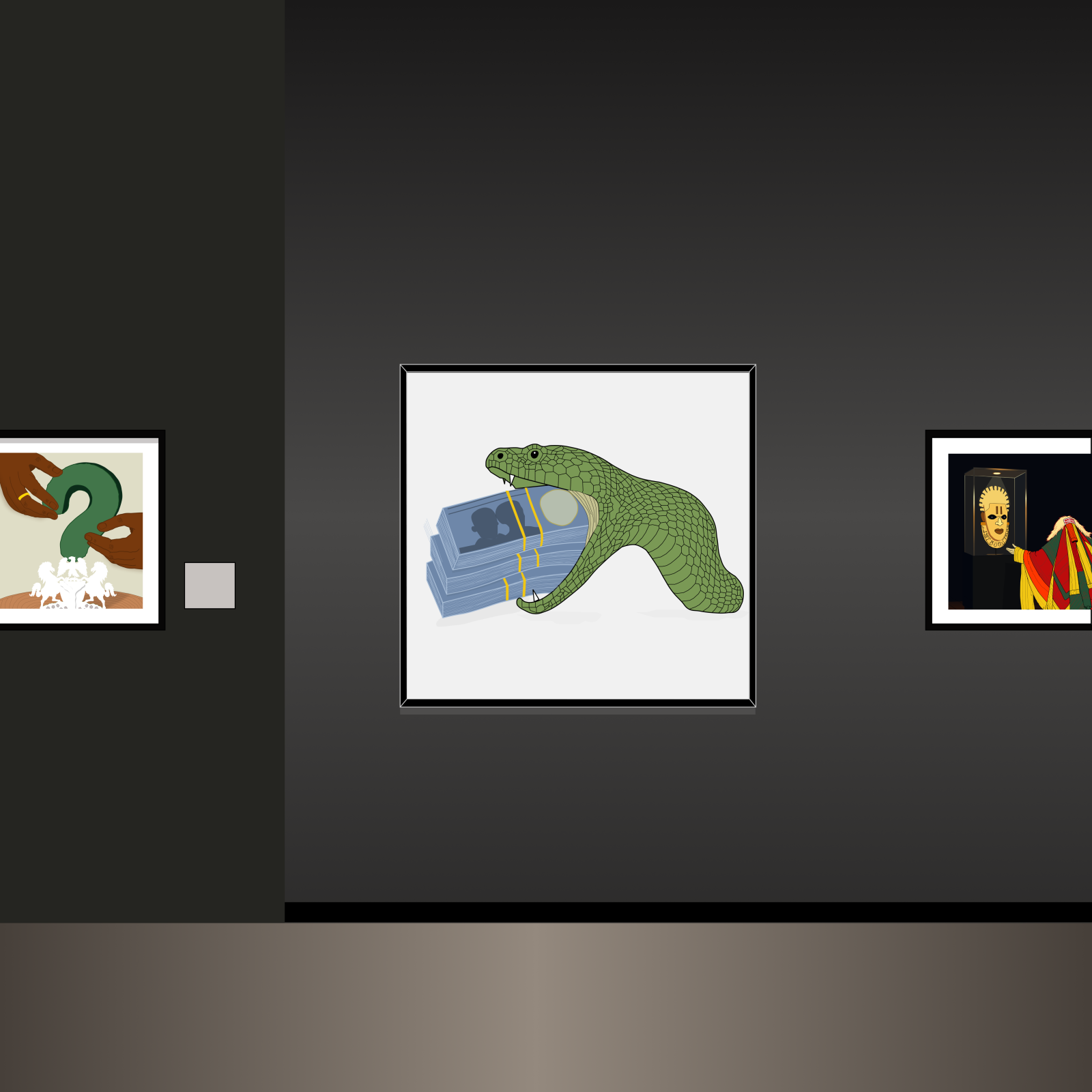
Nigerian artists have long used their medium to confront power by calling out the government. In 1958, the Zaria Rebels opposed the absence of Nigerian traditional art from the university curriculum. A year before independence, Demas Nwoko painted Nigeria in 1959 — three colonial officers with long, drawn faces while barely visible Black figures occupy the background. Art historian Chika Okeke-Agulu described it as perhaps the most poignant commentary by any Nigerian artist on the eve of independence. Then Obiora Udechukwu explicitly made work on the horrors of the civil war, his 1973 woodcut The Exiles (Facing the Unknown), depicting an elderly couple fleeing. We also had Lemi Ghariokwu, the artist behind 26 of Fela Kuti’s album covers, as socially conscious as the music they accompanied. “I believe my art should serve as a tool for social re-engineering,” he said, as recorded by the Daily Maverick.
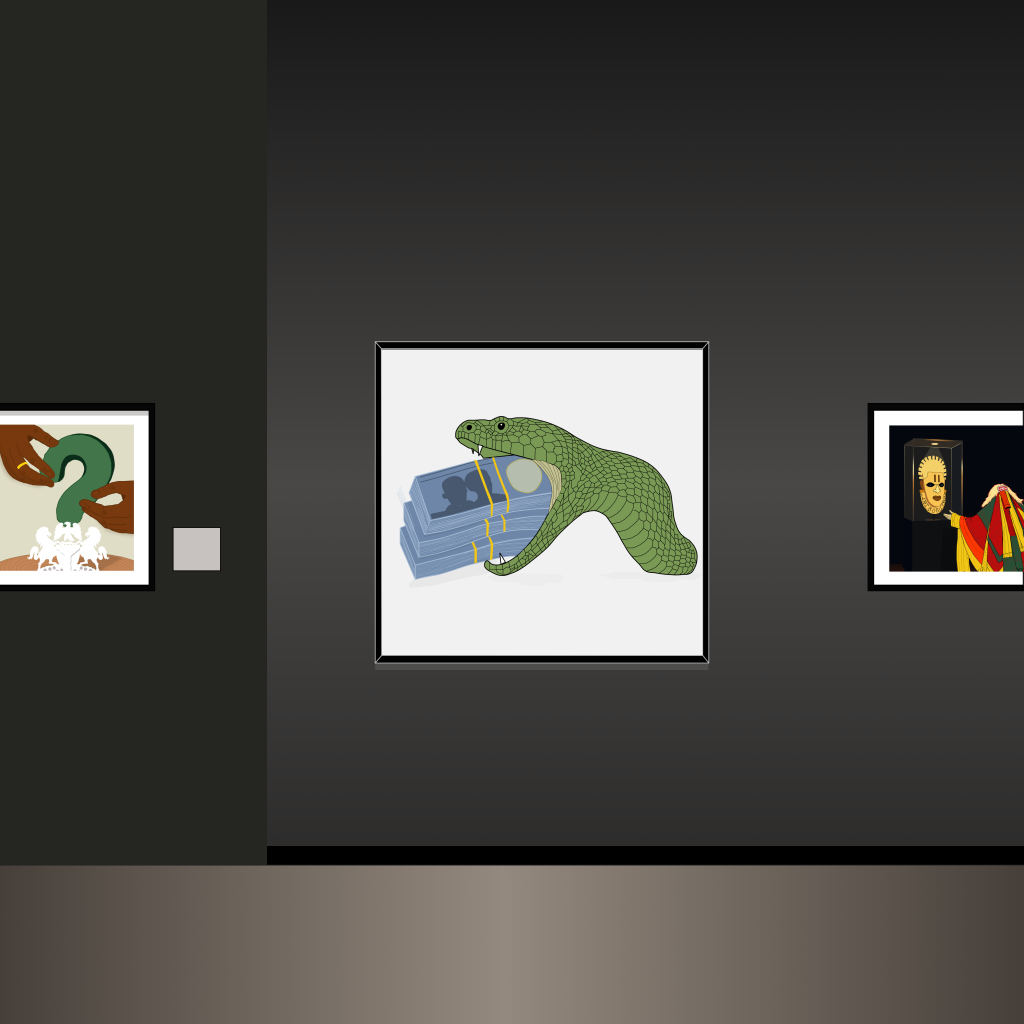
To be an artist in that era was, in many ways, to speak up against colonialism and the corruption and authoritarianism of the new government. This was also evident in other forms; Chinua Achebe and Wole Soyinka used literature to do this same work, likewise Fela Kuti and the Lijadu Sisters through music.
Considering this history, a reasonable question follows: is there a place for the creation and enjoyment of Nigerian art for its own sake, or must it always be regarded as a political tool? Fela Anikulapo Kuti famously described music as “the weapon of the future,” and in an episode of the Kurating Podcast, documentary photographer and filmmaker Omoregie Osakpolor expressed the same conviction that making art for art’s sake feels almost impossible given how much is wrong in this country. Nigeria has consistently given its artists something to respond to, and they have consistently responded. But who gets to dictate what an artist makes, and why does it matter?
Today, when we look at “political” art in Nigeria, many artists continue to respond to the aftermath of colonialism and neocolonialism. As Chibuzor Emmanuel, culture journalist and Program Associate at Angels and Muse, notes, “I think it’s the Western market mostly interested in political art.” He believes that these institutions fund work that engages colonial history or imperialism as a form of reckoning with their own past. Regardless of intention, the effect is that certain kinds of narratives become more visible and regarded as “serious” art.
In comparison, the immediate socio-political climate in Nigeria becomes less visible. There are comparatively fewer works that explore what it actually feels like to live in Nigeria in 2026 under a specific government and a specific set of frustrations. As Emmanuel puts it, “The average Nigerian today would say his major source of problem is Tinubu or his [State] Governor.” If art is being mandated to be political, perhaps it should first begin to reflect the immediate times. Older works in conversation with colonialism remain relevant, especially since those issues have not fully disappeared and have also been the most consistently exhibited and funded. Over time, they have become reference points for what “timeless” art looks like. This feeds younger artists’ perception of what they are expected to continue if they are to remain relevant.
However, these older artists knew the essence of art outside of socio-political messaging, since the majority of them still created art preoccupied with form and pushing medium. For instance, Bruce Onobrakpeya developed pattern and printmaking experiments drawing on Urhobo and Benin traditional art. Even Ben Enwonwu produced extensive portraits of dancers and royal figures simply exploring forms. In that sense, it was never as singularly political as it appears in hindsight. Only that these political artworks took the spotlight and continue to do so, due to direct resonance with the general public.
Another perspective here is that art can be an escape, and even the audience approaches art for that purpose. Not every piece has to address a socio-political issue, especially when the conditions being represented are themselves unresolved. We cannot keep placing the burden of interpretation and documentation on the people already living through those conditions and demand they make art out of it. That would be turning a blind eye to the endless fatigue that comes with surviving Nigeria. Making work that explores the interiority of the human condition, pushing the material boundary or anything other than the constant, often redundant documentation of society’s wrongs, does not make an artist less serious, or even less Nigerian.
Emmanuel argues that “If we want to go by first principles, art is what reinforces our humanity to us.” He traces it back to early human societies where objects were marked and decorated simply for the sake of it, with usefulness or messaging as a secondary purpose. “Humans spend time and energy on things that are not obviously beneficial,” he adds, comparing it to something as ordinary as collecting shells for pleasure. From that perspective, choosing to weave in social commentary — or choosing not to — doesn’t make you any less or more of an artist.
And this is not true of the artist alone. The audience at the receiving end are relevant stakeholders too. Emmanuel notes that African audiences in particular tend to prioritise meaning, not necessarily in a political sense. It is useful in what a work teaches them or how it reflects their own experience. African buyers care less about political optics.
Emmanuel also points to the consequences on the buying side. Collectors weigh what a piece says about them before they buy it, and if your work is politically charged against the people ruling, buying it is almost like saying you are aligning yourself against the government, and most wealthy people do not want to put themselves in such a position.
Looking at our local market, at ART X Lagos, Nigeria’s largest art fair and a majority-local collector base, several of 2025’s fastest-selling works were cultural and spiritually inspired works, hyperrealistic portraits and the like, bought for their craft mastery. It is at the international level (institutional grants, Western museum acquisitions, foundations) where political and historically weighted work tends to be the most consistently rewarded.
The range of what meaningful art can include is endless. An artist’s work might resonate because of its material composition and how it pushes the boundaries of the known, or simply through cultural relevance and an interrogation of the human condition. Sometimes, it resonates for reasons the artist could never predict at all.
Take Ben Enwonwu’s Tutu, three portraits of Yoruba princess Adetutu Ademiluyi, painted just after the civil war. The work had no explicit political message, and yet, because Enwonwu was an Igbo artist painting a Yoruba princess at that particular moment, the painting became a symbol of reconciliation and national unity regardless. This is proof that you do not always have to announce a political statement for one to exist. The artist’s context and the audience’s interpretation can shape what a work means well beyond whatever the artist set out to say.
I felt something similar earlier this year at Praise Sanni-Adeniyi’s exhibition Between a Prayer and a Song, which carried no explicit political undertone either. But standing in that room as a young Nigerian, the sense of liminality the exhibition explores found its way, in my own reading, back to the failed systems of the country, without the work ever touching on that itself. During the artist talk, there was also a conversation about how the figures in the paintings might easily be read as sad, and how expressions of women’s sadness are often dismissed. Even here, questions of politics emerge through the expectations placed on women and the ways their (emotional) lives are received.
Art does not have to be political to matter, and it does not have to try very hard to become political. At the end of the day, art is also an individual experience, shaped as much by the history and desires of the person standing before the work as by the intentions of the person who made it. Even the artist who insists they are simply bringing beauty into the world cannot fully determine what happens once the work leaves their hands.

