


Two years before Nigerian independence from colonial rule, the Yoruba religion had been significantly suppressed by the rise of colonialism and the introduction of Christianity. It was in this quandary that the Head Priestess of Osun sent a call for help to Susanne Wenger, an Austrian artist: the shrines needed to be refurbished. To expedite this grand task, Wenger, who had taken the name Adunni Olorisha and given herself entirely to Yoruba sacred practice, began scouting for people who “had the òrìṣà within them waiting to be aroused.” She found carpenters, tailors, bricklayers, and even former traditional carvers who had left practice because of Christianity. She did not ask them to return; all she did was ask them to find their own artistic language and communicate with God. The work departed from the traditional Yoruba visual culture at the time, but this process was a ritual in itself, what Wenger described as “New Sacred Art”. By the early 1960s, the completion of this mission became the Osun Osogbo Sacred Grove as we know it today.
A short journey away, in Ibadan, something similar was happening through entirely different means. In 1961, Ulli Beier, Wole Soyinka, Christopher Okigbo, J.P. Clark, and Ezekiel Mphahlele turned an old Lebanese restaurant into a cultural centre for art, music, theatre, and literature. The name, Mbari, was suggested by Chinua Achebe, after the Mbari practice of the Igbo people. In the practice, a priest selects a group of people, consecrates them to a forest for months or years, and together they build a house: sculptures of deities and animals, walls decorated in unique patterns, as no two mbari houses ever look the same. Just as with the refurbishment of Osun Osogbo, the entire communal process of this construction was itself a ritual and atonement to Ala.
These two seemingly isolated cases point to a broader phenomenon: the intersection of African spiritual and traditional art, and how it functions as a channel of interposition between humans and the divine across different deities and cosmologies.
Beyond the Mbari house and the refurbishing of Osun Osogbo, the carving of masquerade masks is also common across tribes. The Igbo Mmanwu masks function similarly to the Yoruba Egúngún masks, serving as manifestations of ancestors. Bronze and terracotta sculptures such as the Edo bronzes were created for royal altars and to honour past Ọba. The Nok terracottas also hold ritual and ancestral significance. Likewise, Orisa sculptures, Ifá divination trays, and even Ibeji figures all demand a form of piety and ritual consciousness in their creation.
The importance of these arts meant they were never accessible to everyone. There were clear rules governing who could make what and under what conditions. Families were assigned a specific craft and passed it from one generation to the next. Certain families carved masks; others worked with wood, metal, or clay. These structures also came with gendered boundaries. Women, in many cases, were excluded from particular practices. Bronze casting in Benin, for instance, was restricted to male guilds, in part to prevent the transmission of specialised knowledge beyond sanctioned lineages through marriage. At the same time, these boundaries were not purely exclusionary. In many Yoruba and Igbo communities, practices such as fibre arts, pottery, and body painting, such as uli, were reserved for women and similarly regulated, resulting in a system of specialisation across the board.
***
Strictly speaking, there is no such thing as ‘precolonial Nigerian art,’ because it was never separate from life itself. That unity is precisely what makes colonial disruption and theft so devastating: the removal of these ‘objects’ fractured entire systems of meaning.
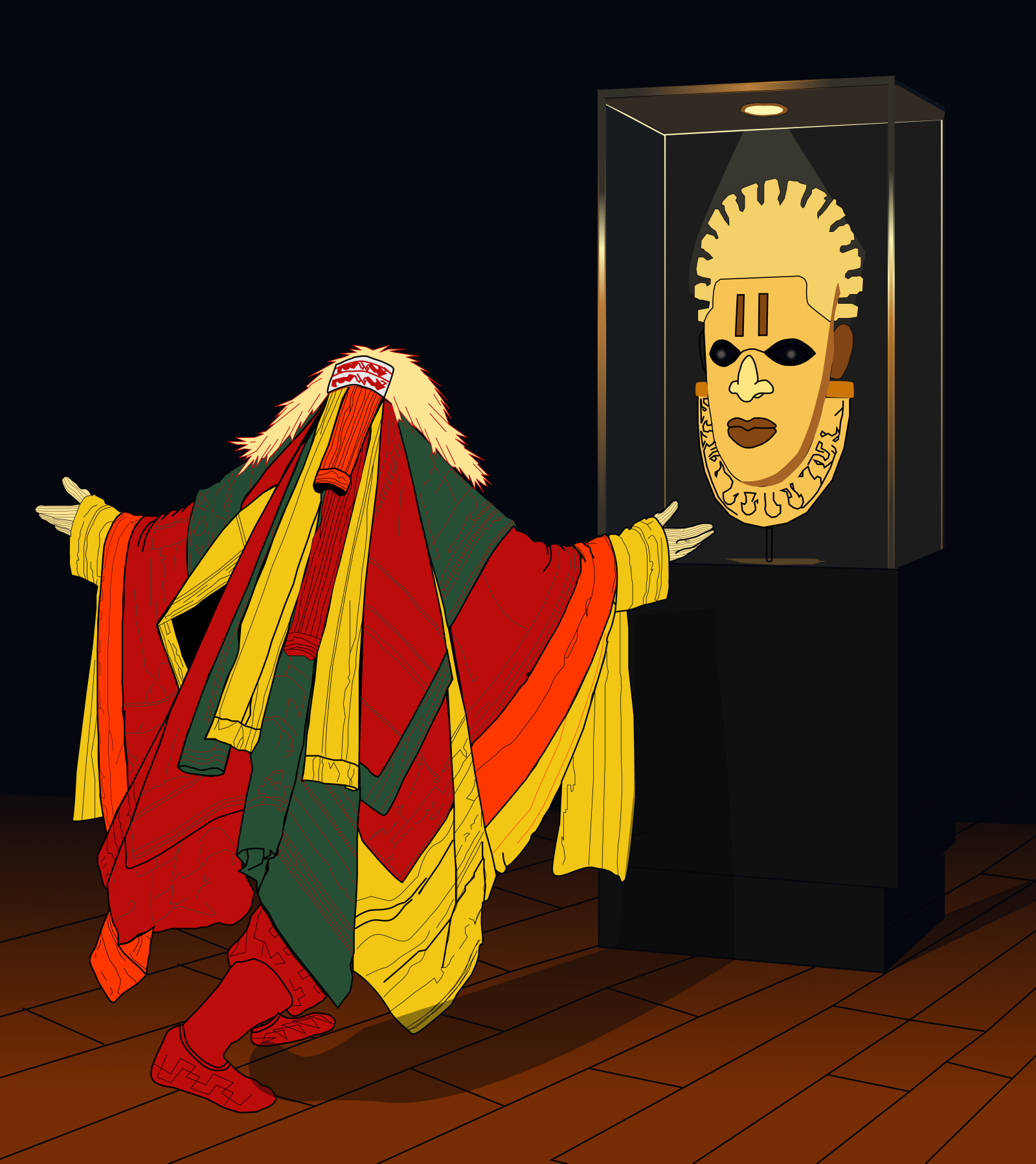
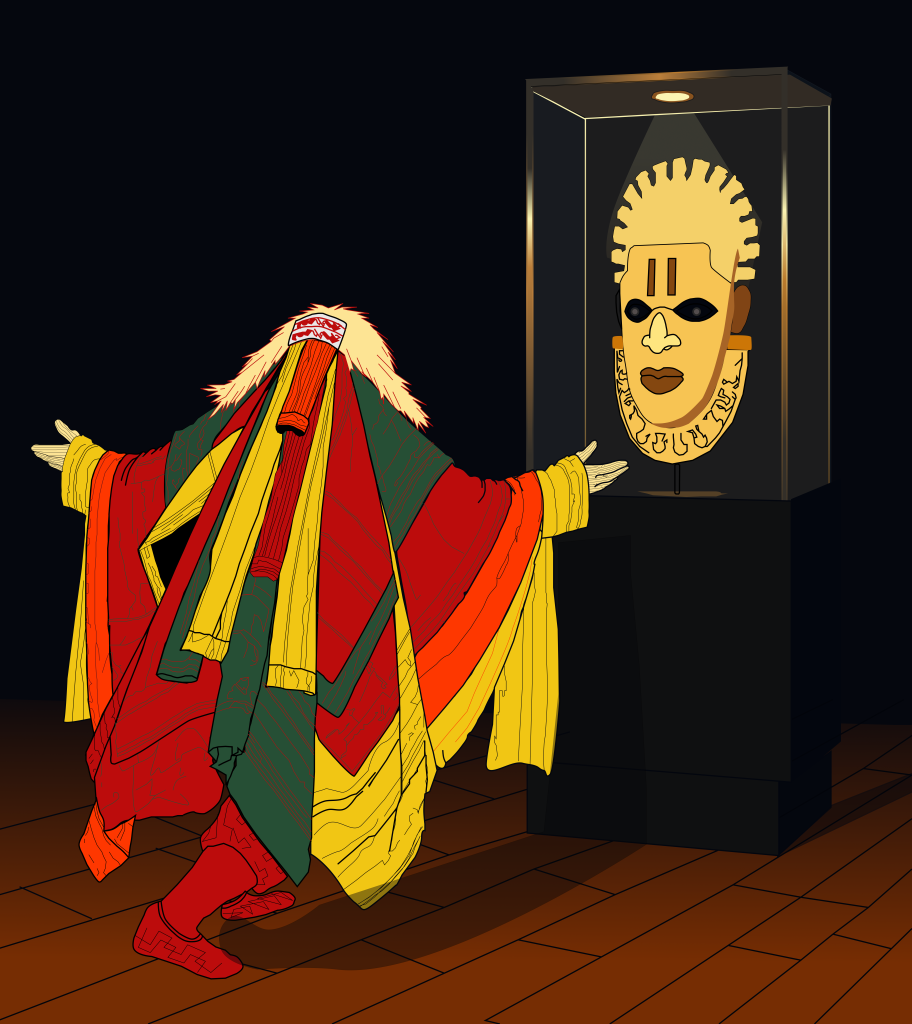
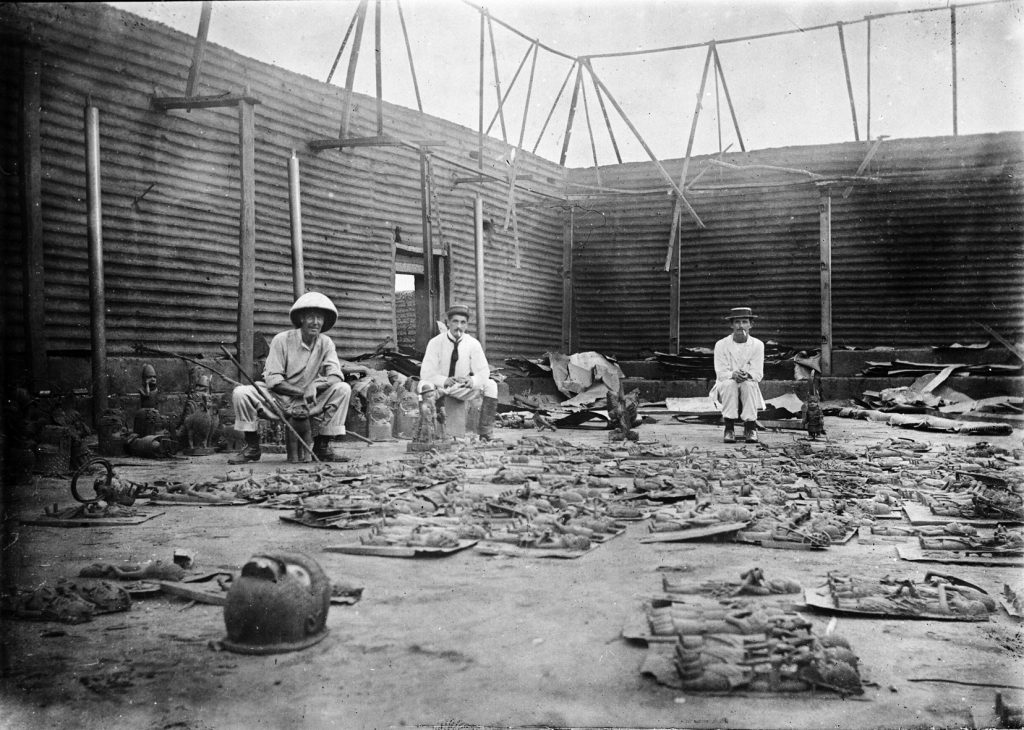
In 1897, British soldiers invaded Benin City during what they called a punitive expedition, a phrase that reveals the sheer audacity of the act. They left with thousands of artefacts: brass heads for royal ancestral altars, brass bells and rattle-staffs used during rituals. Within months of the expedition, these artefacts were on display at the British Museum. Over 900 artefacts remain there today, the largest single collection in the world, followed by the haul at the Ethnological Museum in Berlin. Across at least 165 institutions globally, these collections sit in glass, separated from every condition that gives them meaning, sanitised into spiritual irrelevance. When one considers how these pieces were taken violently and while still in active use, the scale of the rupture becomes even more difficult to ignore.
Then there’s religion. As Islam grew in Northern Nigeria and Christianity gained ground during the colonial era, devotees stopped practising these arts. Traditions were taught to be inferior—demonic, even. Personal journeys towards salvation eroded culture for many tribes. When practitioners converted, as they continue to do today, it meant an end to continuity across generations.
Speaking to The Guardian, Victor Ehikhamenor, a multidisciplinary artist who was part of Nigeria’s first official pavilion at the Venice Biennale, recalled growing up in Udomi-Uwessan, Edo State, where communal prayer spaces were marked “celestially and aesthetically, with signs and symbols to delineate them from regular places.” He laments their disappearance, especially when set against how Western societies preserve their cathedrals and chapels–the Sistine Chapel, for example–as cultural landmarks, even as worship evolves. In 2005, a large Catholic church dedicated to St Peter and St Paul was built in Nise, in present-day Anambra State, on the site of the Mpuniyi Ara shrine, an Igbo sacred land that had drawn people from far and wide to seek the blessings of its deity. This is just one of many examples.
Osaru Obaseki is one of the most internationally exhibited artists of her generation. She works with bronze and sand, drawing from Benin cosmology. Her recent installation, Armoured, takes the fractured walls of the Benin Kingdom as both subject and structure, asking what it means to inherit in fragments. As she puts it: “The 1897 expedition did not only remove works, it displaced an entire system of knowledge where art functioned as archive, ritual and political memory.” And the loss, she insists, is not something that sits only in the past. “It is ongoing, in the way narratives are still mediated, in how cultural value is assigned, and in how descendants sometimes experience a distance from what was once embodied knowledge.”
Seen in this light, the conversation around restitution moves beyond return. Calls for repatriation continue, and some artefacts are beginning to return, including ongoing institutional efforts such as those led by the Museum of West African Art (MOWAA). But the ecosystem has been altered in ways that the return of artefacts alone cannot fix: generations reaching back and having to rework their sense of identity.
Early post-colonial visual artists understood this disconnect in a particular way, because their artistic identity had been formed out of the same precolonial traditions that were being erased. For them, it was the only honest account of where their visual language came from. The late 1950s witnessed Uche Okeke build his own visual language from uli, the Igbo female tradition of body and wall painting he learned from his mother. Bruce Onobrakpeya rooted his printmaking in the decorative traditions of Urhobo culture. Ben Enwonwu was one of the first to draw Igbo spiritual iconography into a modernist style, most explicitly in works like Agbogho Mmuo. Tunde Odunlade, a second-generation artist of the Osogbo school, continued in the same spirit through his textile and batik work.
Younger artists like Victor Ehikhamenor and Peju Alatise continue in this trajectory. For Ehikhamenor, the visual vocabulary originates from the village shrines he grew up around. He began by mimicking these markings as a child, which eventually formed his style. Insisting on this specificity of his source, he says: “So now when you see drips in my work, you would attribute it to someone else? I will be very angry, and I will fight it… I can’t attribute it to anyone, just my village.” Similarly, Peju Alatise draws from Yoruba cosmology to explore how contemporary experience can be understood. However, her installation Flying Girls (2017), presented at the Venice Biennale, was met with backlash from Nigerians and described as “howling demons” – a reaction that shows how colonial religious frameworks continue to shape indigenous cosmological symbols as objects of fear.
***
Today, Nigerian artists continue to explore spirituality in their work through various belief systems. The terrain spans traditions and media. Yagazie Emezi, through textile installations, explores Igbo uli motifs and cosmology. Her work Fall to Ala, shown at Hannah Traore Gallery in New York, takes the Igbo earth goddess as its anchor. Chiagoziem Nneamaka Orji, based in Nsukka, incorporates uli patterns, Nsibidi script, cowries, and masks drawn from Igbo traditions. Her exhibition A Tale of a Century in Nri was recognised by traditional Nze na Ozo chiefs. Fadekemi Ogunsanya paints indigo-toned figures inspired by Yoruba spirituality, exploring the space between human and ancestral presence.
For Adeola Adegbenro, the return to Ifa was revelatory. Raised in Christianity, he describes encountering Ifá as something that stumbled back to him while painting. Since then, it has become inseparable from his practice. His work draws from the Ifá corpus as a philosophical guide for what and how he communicates. Even his recurring use of indigo pays homage to a Yoruba dyeing art unique to a goddess named Iya Mapo.
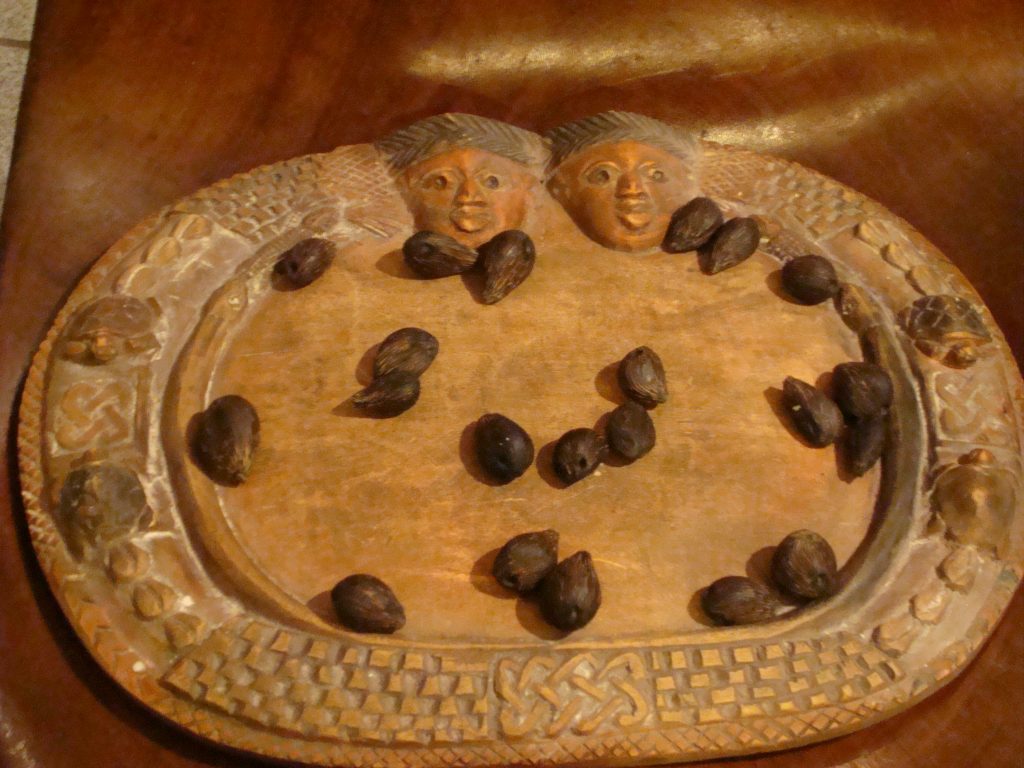
His work is beyond preservation and more about continuation. He is aware that many people who witness his work cannot fully read its symbolic language, as the Ifá corpus is not accessible and needs to be interpreted by practitioners such as Babaláwo. As he emphasises, some will meet the work at the surface, while others, as he hopes, will go deeper. Both, for him, are necessary audiences. On preservation, he explains: “The work is bigger than Yoruba culture, a clarion call to return home. To all people of the same skin. There’s no way we can earn respect, develop our own system, and it’s telling in our lives. We need to continue from where our ancestors stopped before the interruption.”
This thought is also evident in Osaru Obaseki’s practice. She works with bronze, which traditionally excludes women as it is controlled by guilds through family lines and royalty in Benin. The physical casting is done by craftsmen on Igun Street, while she directs the conceptual and sculptural direction of the work. To her, this restraint is part of the medium’s historical language, and she is proud to honour it; she draws a clear distinction between creating sculptural works in bronze and being a bronze caster.
For her, bronze is not a neutral medium but a historically charged material that already carries authority and expectation. As she explains: “I want to be able to keep these histories alive through art, and that is exactly what I am doing with my contemporary bronze pieces and sand paintings in bridging the gap between the old and the new.” Throughout her practice, there is a constant engagement with the transformation of these traditions. In her words: “For me, it’s not about freezing culture in time; it’s about keeping it alive enough to transform.”
These artists today recognise the power in continuity, and continuity is recovered through use. By choosing to engage with these belief systems beyond inspirational material or reference, they do exactly what the artisans at Osogbo did, what the Mbari workers did: make work that is inseparable from life. Our art was never meant to be looked at in the way we do today, hidden behind museum casings. These artists know that. They choose to defy it and pick up the thread whence it dropped.

