

The Lagos art audience is no stranger to archival projects or conversations on the same. In April 2026, the Museum of West African Art (MOWAA) and Guest Artists Space Foundation played host to cultural practitioners and institutions exchanging knowledge about archives and material conservation. The four-day programme themed ‘Archive Fever II: Stewarding Art Archives’ stood as an epitome of the exchanges on archival stewardship happening across Nigeria, reflecting the rising interest in what one might dub “an enlivening of African art libraries.”
As enduring as the conversation on archives is, so is the debate around what constitutes a “living archive” versus a “dead” one. Amalia Sabiescu gives the definition of living archives as “practices and environments that connect the organisation, curation and transmission of memory with present-bound creative, performative, and participatory processes.” To put it simply, the term refers to records collected and designed to function as both reference to the past and tool for creation, memory and transmission in the present. By this definition then, dead archives are those static and immutable repositories that resist re-imagination, access and use. In one article by Rainforest Studio “dead archives” are described as “beautifully organised cemeteries.”
Lagos is home to several important public, state, and specialized archives including those within the Lagos State Records and Archives Bureau, the Centre for Black and African Arts and Civilization (CBAAC), the University of Lagos Library, the Centre for Contemporary Art, and National Museum Lagos. Digital archiving projects, which aim to broaden collections access to Nigerian audiences, also abound: Archivi.ng recaptures lost Nigerian history through the digitization of Nigerian newspapers and magazines; National Museum Lagos’s artifacts digitization project holds 3D digital scans of over 200 authentic Nigerian antiquities and now, the CCA Lagos Archives Digitization Project. Digitizing records and artifacts archives alone does not spell out access to records or knowledge, seeing as all records—no matter their format—will lose their value in the face of non-use. However, with recorded stories of neglect shown towards national archives in Nigeria, all effort is commendable.
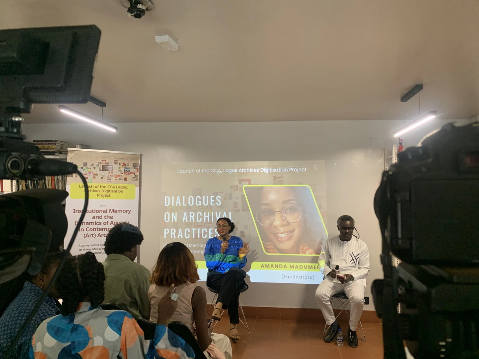
On Friday 24th April, 2026, the Centre for Contemporary Arts Lagos hosted archivists, journalists, art educators, artists and representatives of art institutions at the Lagos Archives Digitization Project Launch and a talk themed ‘Institutional Memory and the Dynamics of Agency in Contemporary Art Archives’. The conversation centered on archives as living sites of memory, power, and cultural production. During a dialogue session led by archivists Amanda Madumere and Joseph Ayodokun, attendees fundamentally re-evaluated the power dynamics of memory (Who gets to claim ownership of an archive once it is created – the archivist or the communities from which materials or knowledge may have been extracted?) questioning what gets recorded, who controls it, and how communities can interact with history in the present (Can selection be neutral? Who decides what is excluded from the archives? What do Nigerians wish to see recorded? How might we design frameworks to trace what records already exist?)
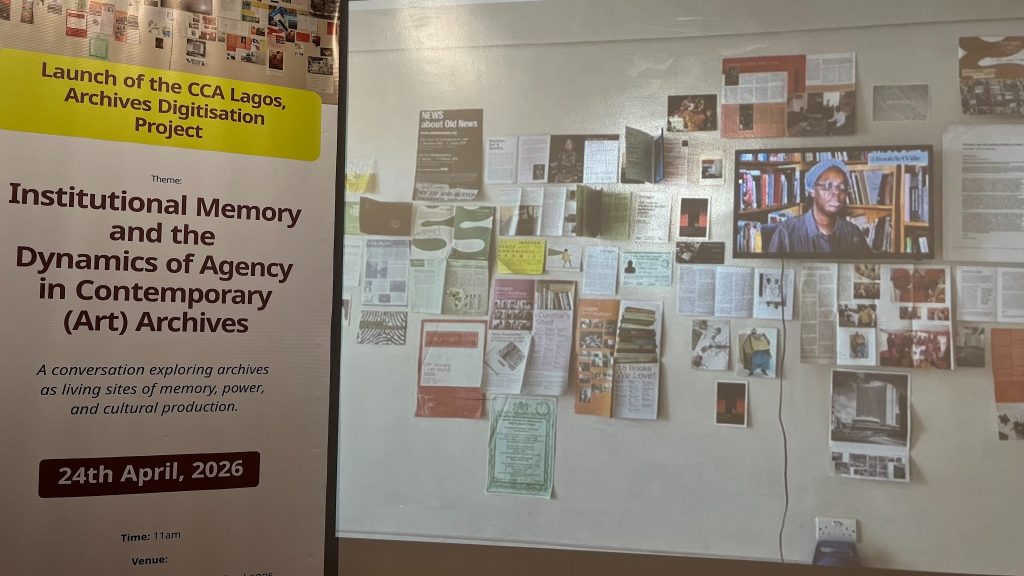
On the motivation behind the launch of the Lagos Archives Digitization Project, Mary Osaretin Omoregie—curator of CCA Lagos—, points to Bisi Silva’s legacy and the centre itself as catalysts behind the creation of the digitization project. The Centre for Contemporary Art (CCA) Lagos was founded in December 2007 as a non-profit-making visual art organization providing a platform for “the development, presentation, and discussion of contemporary visual art and culture”. Its founder, Bisi Silva, prioritized art education and the presentation of underrepresented media in Nigeria such as photography, film and video, performance and installation art. Even after her passing in 2019, CCA Lagos remained a knowledge exchange hub and part-residency for Nigerian artists and curators including Uche Okopa Iroha, Kelani Abbas, and Victoria Udondian. In fact, what is now the ground floor of the CCA Lagos building was once studio space for Nigerian artist and archivist, Amaize Ojeikere, son of J.D ‘Okhai’ Ojeikere!
Post-Bisi-Silva, CCA Lagos has expanded its mission to include the curation of programmes that reflect the diversity of practices, ideas and approaches in contemporary visual art and culture. The institution operates a library and art gallery. The library is home to a collection of over 7,000 books, and a digital archive of 3,000 records (newspapers, brochures, invitations, workshop and exhibition texts) sorted and class marked on a digital list. It is evident then that CCA Lagos’s history and memories condition its present status. Not only does it hold physical records and now a digital archive, its halls and programmes are vital symbols of both institutional and personal memory for many artists.
Borrowing the words of Thorner & Edmunds (2024) who attempt to define what constitutes a living archive, [CCA Lagos might just be] disrupting “assumptions about (and experiences of) archives – as infrastructures (buildings, databases) or repositories of text (books, documents) where one might go to retrieve authorized knowledge – and forge a new kind of archive that can hold-safe and also reinforce dynamic processes of knowledge-making and -sharing.”
The Lagos Archives Digitization Project is expected to be completed by the end of May 2026. Having broached the difficult work of broadening access to its collections to audiences outside its four walls, there remain other parameters for CCA Lagos to set in place. In the future, researchers may ask: “How searchable is CCA’s Lagos Archives to audiences without knowledge of cataloguing or Collection Management Systems?” “How open is CCA Lagos to digital dialogue around its selection process and collection?” “What inter-archive collaborations have there been since the launch of the archives digitization project?” This writer is optimistic. If its ongoing workshop, “Archives in Practice”, is anything to go by, CCA Lagos may be headed in the right direction.

